Thai Visa: Land Border Runs Capped at Two a Year
The 30-day headline got all the attention. The clause that quietly kills the border-hop lifestyle is buried further down the same Gazette notice — and it starts on 15 September.
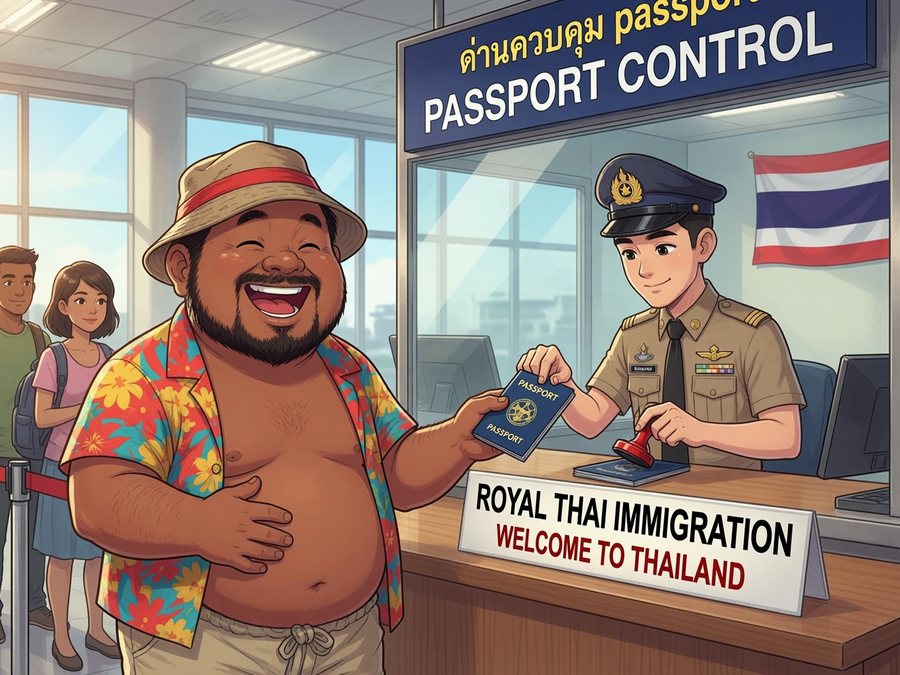
Ministry of Interior notifications published in the Royal Gazette on 31 August take effect on 15 September 2026. The Tourism Authority of Thailand published the country lists on 1 September; Thai media reported the land-border counting rule on 6 September. Air arrivals are not counted. Malaysian, Bruneian, Indonesian and Singaporean passports are exempt from the cap. Six days to go.
Bangkok — The new Thai visa exemption framework does two things at once, and almost every write-up covers only the first. Yes, the 60-day visa-free stamp becomes 30 days on 15 September. The second change matters more if you actually live here: from that date, most nationalities may use the visa exemption at a land-border checkpoint no more than twice per calendar year.
That is not a tightening of the visa run. That is the end of it as a way of living in Thailand. Two crossings. Then the land route is closed to you until 1 January, whatever the officer's mood, whatever the agent in the shopfront tells you.
What the Royal Gazette actually says
The Ministry of Interior notifications published on 31 August set out the replacement framework. Sixty countries and territories — the US, UK, Australia, Canada, Japan, India, most of the EU and the Gulf states — keep visa exemption for tourism at 30 days. Seychelles and Mauritius get 15 days. Azerbaijan, Belarus and Serbia get Visa on Arrival.
Inside those same notifications sits the counting clause. Travellers entering under the 30-day or 15-day exemption through a land-border immigration checkpoint may generally do so no more than twice per calendar year. The exceptions are nationals of Malaysia, Brunei Darussalam, Indonesia and Singapore, plus any nationality the Minister later designates.
Two further details are easy to miss. Air arrivals are not counted, so a flight to Kuala Lumpur and back does not burn a land slot. And the new exemption is framed for tourism. The old 60-day measure carried language covering short business engagements. The replacement does not repeat it.
Two land crossings a year is not a rule you can plan a life around. It is a rule that decides whether you file paperwork this month or next.
Who this hits, and how hard
The people who lose most are not tourists. They are the semi-settled: the Chiang Mai living crowd on a rolling stamp, the Phuket digital nomad who has been running to Ranong every eight weeks, the Bangkok expat waiting for a work permit and topping up with a Poipet day trip. That pattern was already under pressure in 2026. On 15 September it becomes arithmetic.
Run the numbers honestly. Under the old system, a 60-day stamp plus a 30-day extension gave roughly 90 days per cycle, and four land runs a year covered most of it. Under the new system: 30 days plus a 30-day extension is 60 days per cycle, and only two of those cycles can start at a land border. That is about four months of legal presence from land crossings, not twelve.
| Pattern | Before 15 Sept | From 15 Sept |
|---|---|---|
| Stamp on arrival | 60 days | 30 days |
| Extension at immigration | +30 days, 1,900 baht | +30 days, 1,900 baht |
| Land-border entries a year | Effectively unlimited in practice | Two, most nationalities |
| Air entries a year | Not formally capped | Not counted under this clause |
| Business activity permitted | Limited allowance under the 60-day measure | Tourism framing only |
The catch nobody mentions: flights are not a loophole
Because air arrivals are not counted under this clause, the obvious workaround is to fly out and back instead of taking the minivan. That works mechanically. It does not work legally, and it does not work at the counter forever. Thai immigration rules have always given officers discretion over repeat visa-exempt entries, and a passport showing six or eight exemption stamps in a year invites a secondary interview whether you arrived by air or by bus.
It also costs money. A Bangkok–Kuala Lumpur return runs 4,000 to 7,000 baht depending on season, against roughly 1,500 to 2,500 baht for a Nong Khai or Poipet run with an agent. Six flights a year is 30,000 baht or more, spent on the privilege of remaining a tourist. A DTV visa Thailand application costs 10,000 baht once and buys five years.

Thai visa requirement: what to do in the next six days
If you are inside Thailand now
A stamp issued on or before 14 September keeps the period granted on arrival. A 60-day stamp collected on 12 September still runs to mid-November, and you can still apply for the 30-day extension at your local office. Nothing is retroactively shortened. It is the next entry that lands under the new rules.
If your plan depended on land runs
Stop treating the border as infrastructure and pick a route. For remote workers, the DTV visa Thailand is the usual answer: five years, 180 days per entry, one 180-day extension inside the country, foreign employers or clients only. Since 31 August it also requires a criminal record certificate and must be filed at the mission covering your citizenship or legal residence — the Vientiane shortcut is closed. Budget 500,000 baht of seasoned savings and four to eight weeks.
For anyone over 50, the Thailand retirement visa route still works on 800,000 baht in a Thai bank or 65,000 baht a month of pension income. It is slower and more document-heavy than the DTV, but it renews annually and immigration officers understand it. Our full Thailand retirement visa guide covers the seasoning periods and the insurance differences between the Non-O and O-A subtypes, which trip up more applicants than the money does.
Provincial variation is real
Do not assume Chaeng Watthana practice equals Jomtien practice equals Chiang Mai practice. Extension approvals, document lists and the tolerance for repeat exemption entries differ office to office and always have. The counting clause is national; the way it is enforced on a borderline case will not be. If you are close to the line, go in person, go early in the day, and take more paper than you think you need.
Key takeaways — 9 September 2026
- Two land entries a year, most nationalities. From 15 September the Thai visa exemption can be used at a land checkpoint twice per calendar year. Malaysia, Brunei, Indonesia and Singapore are exempt.
- Air arrivals are not counted under this clause — but officer discretion over repeat exemption entries has not gone anywhere.
- The exemption is tourism-framed. The short business-activity language in the old 60-day measure was not carried over.
- Existing stamps survive. Enter on or before 14 September and you keep the stay you were granted.
- Do the maths. Two land cycles at 60 days each is roughly four months. If you need twelve, you need a visa, not a routine.
The honest summary
Thailand has not banned anyone. It has removed the cheap, informal path that a lot of people used instead of a Thai visa, and it has done so with a clause most coverage skipped. If you are a genuine tourist, the cap will never touch you. If you have been living in Thailand on a stack of exemption stamps, the cap is the whole story.
The cost of living in Thailand argument that made the border run attractive — a few thousand baht a quarter versus a proper visa — no longer holds once you price in flights, lost days and the risk of a refusal that follows you through every future entry. Renting in Thailand on a 30-day clock was already awkward. Thailand healthcare for foreigners is fine if you can pay for it, and a tourist stamp buys you nothing there either. These are relocation costs, and they are now easier to justify than the alternative.
Verify your own position before you book anything. Check your nationality against the Royal Gazette lists, check the mission that actually covers you, and count the land crossings already in your passport for 2026. Then run the free Thailand visa finder against your age, income and work pattern. The agent selling a border package for 16 September is not the person who will be standing at the counter when it is refused.
Sources
- TAT Newsroom, 1 September 2026 — official 30-day, 15-day and Visa-on-Arrival lists and the land-border limit
- The Thaiger, 6 September 2026 — reporting on the two-entry land-border cap and ASEAN exceptions
- Royal Gazette — Ministry of Interior notifications published 31 August 2026
- Thai e-Visa portal — official application channel for TR, METV and DTV
- Thai Immigration Bureau — extensions of stay and provincial office contacts
This article is for informational purposes only and is not legal or immigration advice. Confirm your nationality's treatment against the Royal Gazette notifications, the TAT notice and the Royal Thai mission that covers you before making travel or relocation decisions. Verified 9 September 2026.