Retire in Thailand: UK Confirms Pension Freeze Stays
Britain's Pensions Minister has just reconfirmed what campaigners have argued for years: a UK state pension paid into Thailand never rises again, no matter how long you live here. Here is what that permanent freeze really costs over a retirement — and why it collides with Thailand's own visa income rule more directly than most guides admit.
This is not a new law. Pensions Minister Torsten Bell restated existing UK policy to MPs on 2 June 2026, and the confirmation has been recirculating hard through Thai expat and UK press all this week. Nothing about your current Non-O extension, income proof, or 90-day reporting changes today. What is new is the confirmation that no reform is planned — and campaigners argue that matters far more for a twenty-year retirement plan than for next month's paperwork.
Bangkok — If you retire in Thailand on a UK state pension, the figure on the award letter the day you first draw it here is, in practical terms, the only figure you will ever see. Pensions Minister Torsten Bell told MPs on 2 June that the rule stands: pensions paid into Thailand do not rise with inflation, the triple lock, or anything else, because Thailand has no reciprocal social security agreement with the UK covering pension uprating. The statement is almost four months old, but it has been tearing through Thai expat forums and UK press again this week, for one simple reason — it confirms there is no fix coming. For anyone weighing whether to retire in Thailand on a British pension, or already living here on one, that is worth working through properly, because the numbers behind it collide with Thailand's own retirement visa rules and Thai immigration rules on income proof in a way most guides skip entirely.
What was actually confirmed, and when
Torsten Bell, who kept the pensions brief through Prime Minister Andy Burnham's July 2026 reshuffle, told Parliament on 2 June that annual pension uprating "only applies where there is a legal requirement, usually under a reciprocal agreement," and that Thailand has none. He gave no timetable for change and pointed out that ending the freeze for every affected pensioner worldwide would cost the UK Treasury an estimated £930 million a year — the number ministers keep citing as the reason reform is not coming soon. The campaign group End Frozen Pensions, which has lobbied on this for over a decade, says roughly 453,000 UK pensioners live in countries where the state pension is frozen, out of about 1.1 million receiving it overseas in total, and claims 86% of those affected had no idea the rule existed before they relocated. None of that is new policy. What changed this week is simply that it was said again, on the record, with no softening — which is exactly why it is circulating through Thai expat channels as news rather than history.
The mechanic behind “frozen” — and the neighbour that got a better deal
The rule itself is simple and almost never explained well. The UK state pension rises every year for pensioners living in the UK, the EEA, Switzerland, and a short list of countries with a reciprocal social security agreement that specifically covers pension uprating — the United States, Israel, the Philippines and several Caribbean and Balkan states among them. Everywhere else, the amount you were paid the day you started drawing it abroad is the amount you will keep drawing, in pounds, for the rest of your life, regardless of UK inflation. Thailand sits firmly in the second group. The detail that tends to land hardest with retirees here is the comparison: a British pensioner who retires to Manila gets the same annual increase as one who stayed in Surrey, because the Philippines has the reciprocal deal Thailand does not. A British pensioner in Chiang Mai, Hua Hin, or Bangkok gets nothing, forever, for no reason connected to need, contributions, or cost of living — only to which government signed which agreement, decades ago.
The number the visa guides don't put next to this
Here is the part that matters if you are actually planning to retire in Thailand rather than just reading about the politics of it. The full new UK State Pension from April 2026 is £241.30 a week — about £1,046 a month. At the GBP/THB mid-market rate on 27 September 2026 (roughly 44.3 baht to the pound), that converts to approximately 46,300 baht a month. Thailand's retirement visa — the Non-O extension — lets you qualify through a monthly income of 65,000 baht, a lump sum of 800,000 baht held in a Thai bank account for at least three months, or a combination of the two. Run the numbers and a full, entirely unfrozen, maximum-rate 2026 state pension still falls roughly 18,700 baht a month short of the income route on its own. Freezing does not create this gap — it just guarantees it can never close. Anyone whose pension iced years ago at a lower rate, and DWP figures confirm some long-frozen awards sit as low as £20 a week, is nowhere near either threshold on pension income alone. For most British retirees here, the honest reading is that the 800,000-baht deposit route, or a combination of savings and a smaller income figure, was already the realistic path before this week's news, not something the freeze changed. Our Non-O retirement visa guide breaks down both routes and the three-month seasoning rule the deposit method requires.
| Pension scenario | Weekly (GBP) | Approx. monthly (THB) | Vs. Thailand's 65,000-baht income route |
|---|---|---|---|
| Full 2026 rate, not frozen | £241.30 | ~46,300 baht | Falls ~18,700 baht short |
| Frozen a decade or more (typical range) | £130–£170 | ~25,000–33,000 baht | Falls ~32,000–40,000 baht short |
| Lowest reported frozen awards | £20 | ~3,800 baht | Not realistic on its own |
| Thailand's bank-deposit route | n/a | 800,000 baht (held 3+ months) | Works regardless of pension size |
Return to the UK and it thaws — leave again and it refreezes
One mechanic worth knowing before you assume the freeze is permanent in every sense: it is tied to residence, not nationality or the pension itself. A pensioner who moves back to the UK can apply to the Department for Work and Pensions to have their payment uprated to the current full rate — but only for as long as they are actually resident in the UK, and the increase is not backdated to cover the frozen years. Leave again, whether back to Thailand or anywhere else without a reciprocal agreement, and the pension freezes a second time at whatever the current rate happens to be on the day you go. That makes "spend six months a year in the UK" a genuinely different financial strategy from "retire in Thailand full-time," not just a lifestyle preference, and it is a detail that gets left out of most retire-in-Thailand guides entirely.
A full, unfrozen UK state pension already falls short of Thailand's 65,000-baht income rule. Freezing does not create that gap. It just guarantees it never closes.
What this actually means for your Thailand retirement plan
If you are budgeting to retire in Thailand on a British pension, the sensible move is to stop modelling any future increase into your plan at all. Treat the rate on your first payslip abroad as the rate for the rest of your life, and build your visa math and your cost of living in Thailand budget around that number, not a hoped-for rise. In practice that means leaning on the 800,000-baht deposit route, or a documented combination of savings and income, rather than assuming pension income alone will clear the bar — and keeping the deposit seasoned for the full three months immigration officers actually check. It also means budgeting properly for healthcare: Thailand has no S1-style reciprocal arrangement with the UK, so private cover in your sixties and seventies is a real annual cost, not an afterthought, something our health insurance rules guide covers in more depth. And it is worth stacking this alongside a separate pressure we covered two weeks ago: a firmer baht has already been quietly cutting what a frozen pension buys, on top of the freeze itself, which our strong-baht cost-of-living piece lays out in full. The one genuinely actionable step for anyone still on a UK electoral roll is registering to vote from abroad, which campaign groups argue is the only real lever pensioners currently have on this policy — not a fix, but the honest options are limited to that and to planning around the number you already have.
Retire in Thailand key takeaways — 28 September 2026
- Reconfirmed, not new: Pensions Minister Torsten Bell restated on 2 June 2026 that pensions paid into Thailand get no annual increase, with no reform planned.
- The visa math nobody prints: a full, unfrozen 2026 state pension (~46,300 baht/month) already misses Thailand's 65,000-baht income-route threshold by around 18,700 baht.
- Some frozen awards sit as low as £20/week — for most retirees, the 800,000-baht deposit route is the realistic path, not pension income.
- The freeze is about residence, not nationality: move back to the UK and it thaws to the current rate (not backdated); leave again and it refreezes.
- Neighbours get better deals: the Philippines has a reciprocal agreement and gets annual rises; Thailand does not.
- Budget on today's number, permanently — and price in private healthcare, since Thailand has no reciprocal S1-style cover.
Sources
- The Thaiger, 26 September 2026 — recirculation of the frozen-pension confirmation, campaign group figures, cost estimate to reform
- ASEAN NOW — Torsten Bell's 2 June 2026 statement to Parliament and direct quote
- Thailand Construction and Engineering News — End Frozen Pensions campaign figures and ministerial response
- Retirement Abroad UK, 2026 guide — Non-O income/deposit route figures, healthcare cost ranges
- Wikipedia: Frozen state pension — reciprocal-agreement country list and the UK-residence uprating mechanic
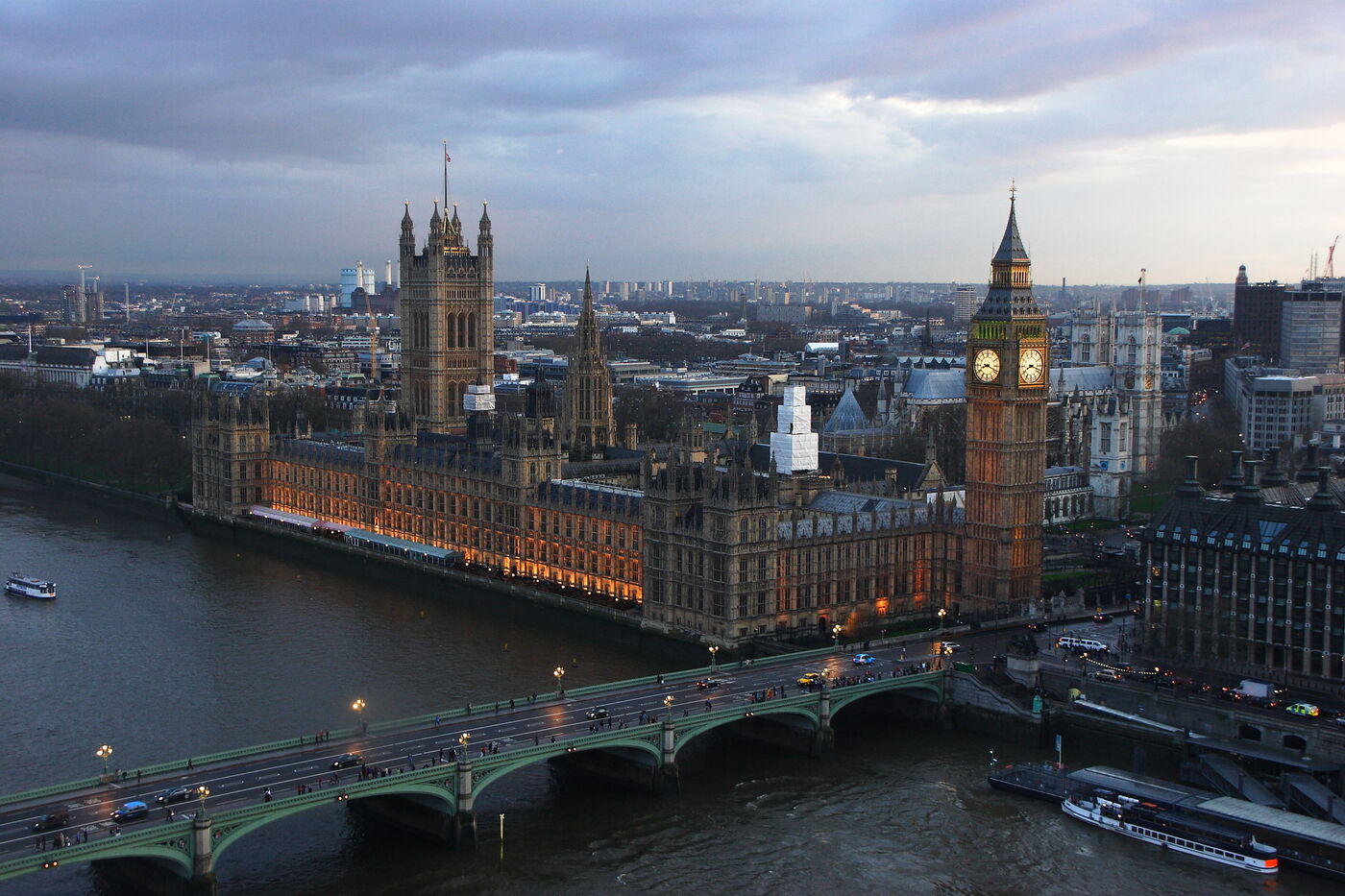
- Wikimedia Commons — Palace of Westminster photo, CC BY-SA 3.0, credit: Daniele Vaghini
- Wikimedia Commons — Hua Hin beach photo, CC BY-SA 3.0, credit: Supercarwaar
This article is for information only and is not legal, tax, immigration or financial advice. Pension figures, exchange rates and visa thresholds change; confirm your own state pension forecast directly with the UK Department for Work and Pensions (gov.uk) and current Thai visa financial requirements with Thai Immigration before relying on any figure here. Verified 28 September 2026.